🔴 Invasive - Remove
Asiatic Bittersweet
Celastrus orbiculatus
This is an invasive species that harms native ecosystems. It should be removed when found to protect local plant and wildlife habitats.
Celastrus orbiculatus
This is an invasive species that harms native ecosystems. It should be removed when found to protect local plant and wildlife habitats.
Asiatic bittersweet is a highly aggressive, invasive vine that wraps around trees and shrubs, girdling and eventually killing them. It can also climb and smother entire forest canopies, displacing native plants and harming wildlife habitats.
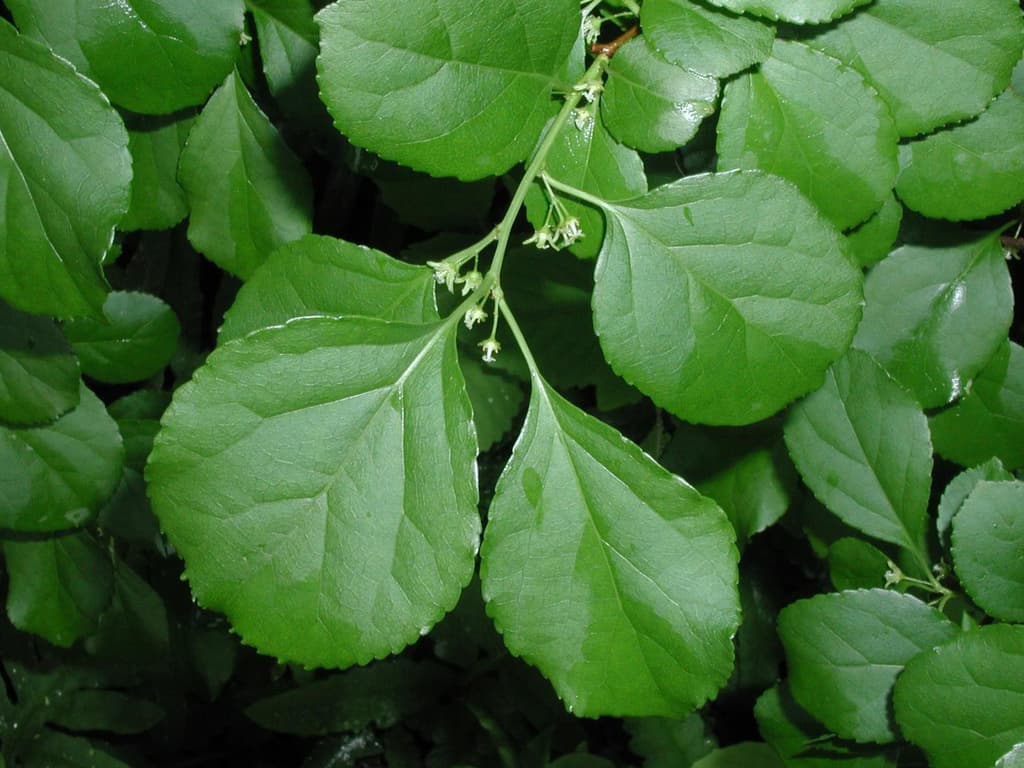
Colour and texture: Glossy mid-green, turning clear yellow in autumn. Stems are brown with obvious raised dots.
Fruit September–November, often hanging into winter.
Yellow capsules that split into three to show a scarlet-orange seed, carried in small clusters all along the stem where each leaf joins it.
Why it matters: Position is the native check: our native American bittersweet fruits only in one bunch at the very tip of a branch. And every wreath cut from it plants a hedgerow.
A woody vine climbing a tree. This is the safe way to free a tree: you never pull a vine down out of a canopy.
Avoid: Do not haul the vine down. It is tangled into the branches, and pulling brings down deadwood on top of you.
Any plant carrying ripe seed or fruit. Once you start dragging it, you are sowing it.
It can stay on site. Cut vine can stay. Leave the high pieces to die in the tree and pile the rest clear of the soil.
American bittersweet is now rare, partly because Asiatic bittersweet hybridises it away, and partly because people cut both for autumn wreaths. In fruit they are easy to separate, and you can do it from several feet back: look at WHERE the berries are, not what colour they are.
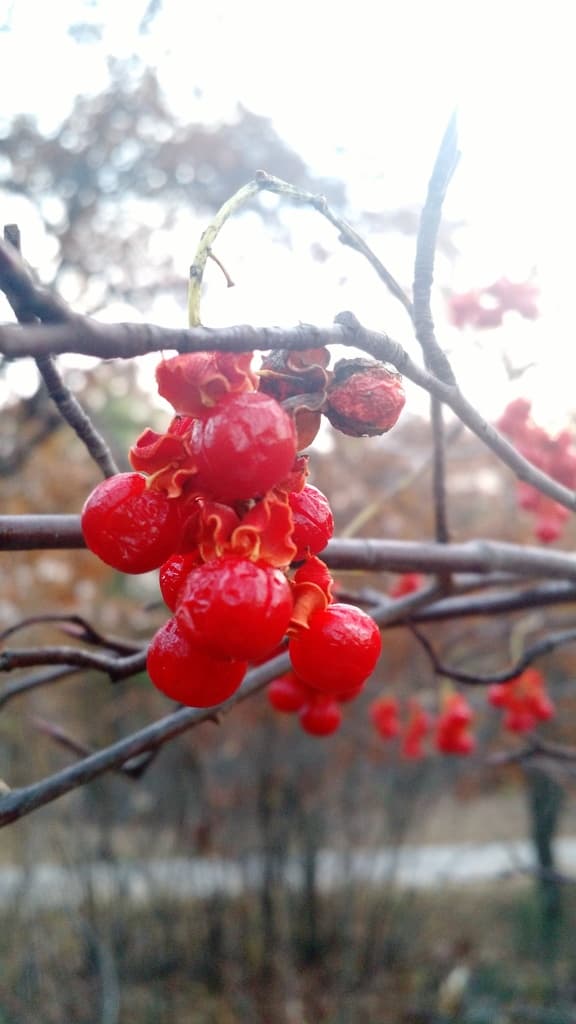
American Bittersweet
Celastrus scandens
Native: keepOne bunch, at the very tip of the stem.
Avoid: Do not carry a fruiting plant across the site to a pile. That walk is how the next patch gets planted.
Before the first cut: Cut at the base and as high as you can reach without pulling on the tree; leave the top to die in the canopy.
How to remove it:
• Cut and Pull: Cut the vine near the base and again as high as you can reach without pulling tree branches. Remove the section in between to stop regrowth through connection. If possible, remove roots as well to prevent resprouting.
• Dig out roots: Pull small plants completely if the ground is soft. Can regrow from root fragments, so remove as much of the root system as possible.
• Follow up: Watch for resprouting in the same area and remove new growth promptly.
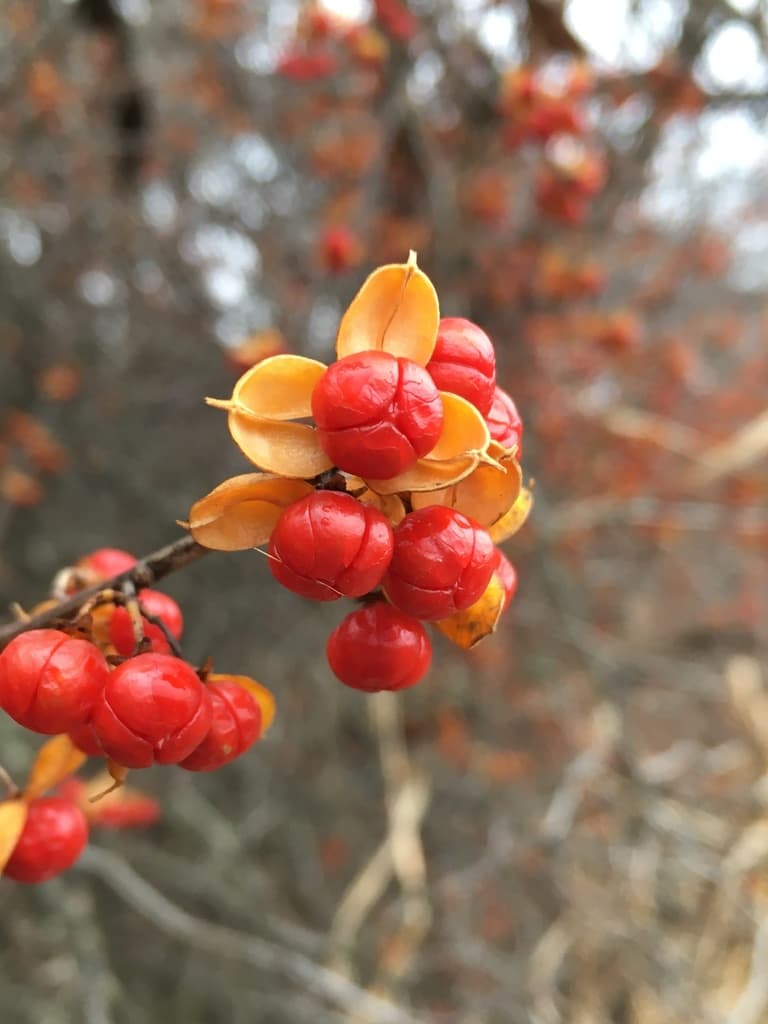
Asiatic Bittersweet
Celastrus orbiculatus
Invasive: removeClusters all the way along the stem.
American Bittersweet
In a single bunch at the very end of a shoot, and nowhere else on the stem.
Asiatic Bittersweet
In small clusters all along the stem, tucked in where each leaf joins it.
American Bittersweet
Orange, splitting to a scarlet seed.
Asiatic Bittersweet
Yellow, splitting to a scarlet seed. Useful, but the position above is the check that holds.
American Bittersweet
Longer than wide and tapering at both ends, more of an ellipse.
Asiatic Bittersweet
Round to broadly oval, often as wide as it is long, and glossy.
American Bittersweet
Do not. It is uncommon, and the berries are winter bird food.
Asiatic Bittersweet
This is exactly how it got into every hedgerow in the region. Bag the fruit; it does not go in a brush pile.
When in doubt, leave the plant and ask a site lead before removing it.