🔴 Invasive - Remove
Japanese Honeysuckle
Lonicera japonica
This is an invasive species that harms native ecosystems. It should be removed when found to protect local plant and wildlife habitats.
Lonicera japonica
This is an invasive species that harms native ecosystems. It should be removed when found to protect local plant and wildlife habitats.
A twining, semi-evergreen vine with paired oval leaves and sweetly scented white flowers that fade to yellow. It carpets the ground and climbs shrubs and small trees, staying green well into winter after natives have dropped their leaves.
Native to: East Asia (Japan, Korea, China)
Brought to Long Island in 1806 as an ornamental and later planted widely for erosion control and as deer browse. It escaped everywhere it was planted and is now one of the most common vines in Mid-Atlantic woods.
Smothers ground-layer plants and girdles saplings as its stems tighten around them. Because it keeps its leaves into winter it shades out spring wildflowers before they emerge, and birds spread its black berries into every hedgerow.
Colour and texture: Plain mid-green, smooth-edged, semi-evergreen. Young stems are reddish and hairy; old vines have shaggy tan bark.
Leaves: opposite pairs, oval, 1–3 inches, usually smooth-edged (young leaves near the base can be lobed). Semi-evergreen — still green in December.
Stems: young stems are reddish and hairy; older vines have shaggy, peeling tan bark. Stems twine and root wherever they touch the ground.
Flowers: paired, tubular, white ageing to yellow, strongly fragrant, May–June.
Berries: small and black, in autumn.
Berries September–November.
Small, shiny black berries in pairs where the leaves join the stem.
Why it matters: Black berries in pairs separate it from native coral honeysuckle, whose berries are red. It is birds eating those berries that put it in every hedgerow.
Anything with a taproot or shallow roots: garlic mustard, mile-a-minute, seedlings, honeysuckle runners.
Avoid: Do not yank. Speed is what snaps the stem at the root collar and leaves the half that matters behind.
A plant that travels sideways and roots where it touches: kudzu, Japanese honeysuckle, ivy runners.
It can stay on site. Cut vine can stay, but keep it off the soil: this is one of the ones that roots wherever a node touches dirt, so a pile left flat re-roots into a mat.
Coral honeysuckle is a native vine that hummingbirds depend on, and it is regularly pulled by mistake because "honeysuckle" reads as invasive. Two checks, neither of which needs a flower.
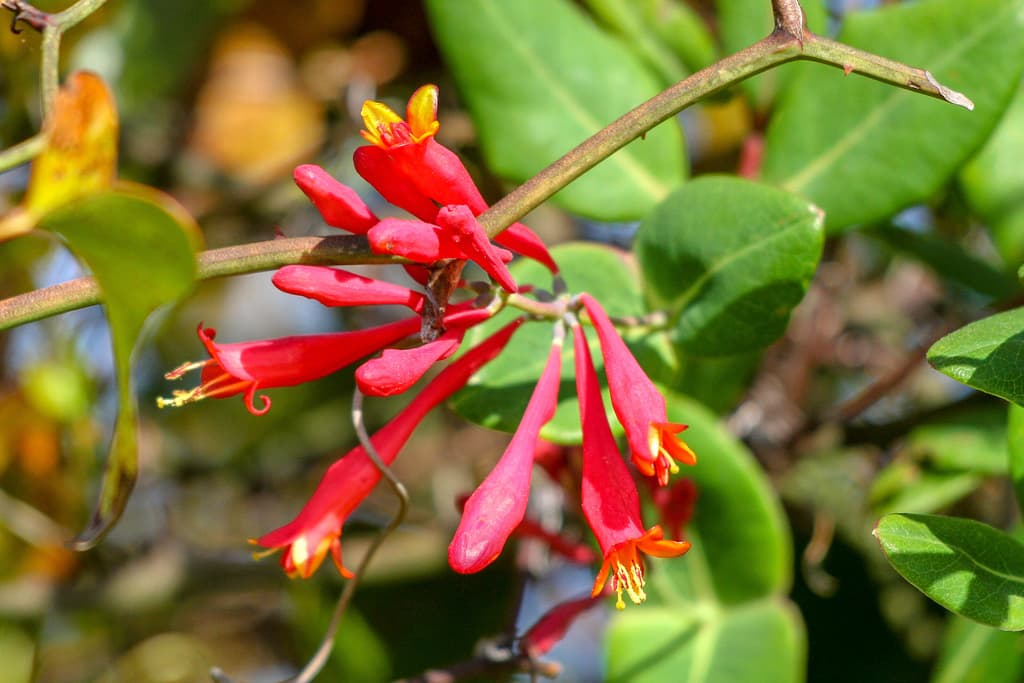
Coral (Trumpet) Honeysuckle
Lonicera sempervirens
Native: keepRed trumpets in whorls at the shoot tips.
A woody vine climbing a tree. This is the safe way to free a tree: you never pull a vine down out of a canopy.
Avoid: Do not haul the vine down. It is tangled into the branches, and pulling brings down deadwood on top of you.
Before the first cut: Pull slowly and the runners come up in long strands; every rooted node you leave behind re-sprouts.
Seedlings and small plants: hand-pull. Young plants (under about two years) come up whole if you pull slowly, and the runners follow in long strands. Get the rooted nodes or they re-sprout.
Established vines: do not try to rip out big roots — they fragment and every piece re-sprouts. Cut at the base and again at shoulder height, pull what comes easily, and note the patch for the coordinator; the extension services' advice for large stands is a fall herbicide treatment, when it is still green and natives are dormant.
Best window: late autumn through early spring. It is still green while the natives around it are bare, so it is easy to see and you are not trampling wildflowers.
Japanese Honeysuckle
Lonicera japonica
Coral (Trumpet) Honeysuckle
Fused into a single disc that the stem grows straight through, like a collar. Look at the last few inches below the flower head.
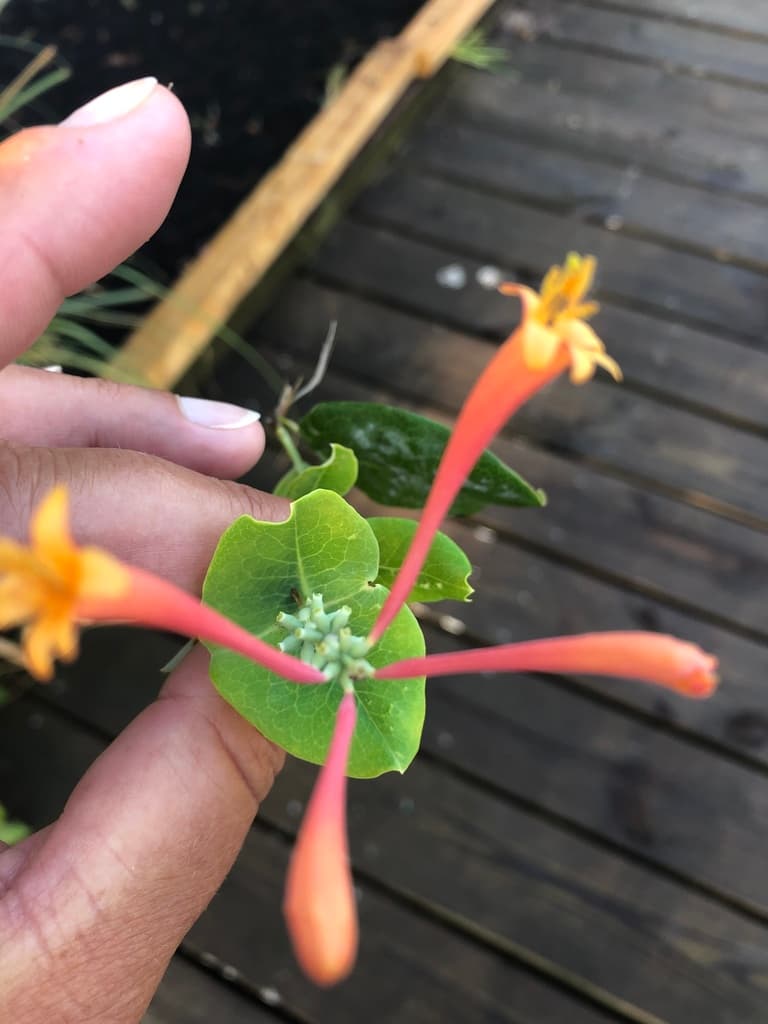
Japanese Honeysuckle
Never fused. Every pair stays as two separate leaves the whole way up.
Coral (Trumpet) Honeysuckle
Blue-green and waxy, smooth on both sides.
Japanese Honeysuckle
Plain mid-green; young leaves near the base are sometimes lobed, and young stems are reddish and hairy.
Coral (Trumpet) Honeysuckle
Red to orange trumpets in whorls at the tips of the shoots, yellow inside, and almost scentless.
Japanese Honeysuckle
Paired white trumpets that age to yellow, down the length of the stem, and powerfully fragrant.
Coral (Trumpet) Honeysuckle
Red.
Japanese Honeysuckle
Black.
Coral (Trumpet) Honeysuckle
Twines politely up a shrub or trellis and stays where it is put. It does not run along the ground.
Japanese Honeysuckle
Carpets the ground and roots at every node, then spirals tight enough around saplings to leave a corkscrew groove and girdle them.
When in doubt, leave the plant and ask a site lead before removing it.