🔴 Invasive - Remove
Norway Maple
Acer platanoides
This is an invasive species that harms native ecosystems. It should be removed when found to protect local plant and wildlife habitats.
Acer platanoides
This is an invasive species that harms native ecosystems. It should be removed when found to protect local plant and wildlife habitats.
A common street tree that seeds itself into every nearby woodland. Broad five- to seven-lobed leaves, milky sap in the leaf stalk, and a canopy so dense that nothing grows beneath it. Carpets of its seedlings crowd out native maples and oaks.
Native to: Europe and western Asia
Introduced in 1756 by the Philadelphia nurseryman John Bartram and planted on streets across the country for two centuries, especially as a replacement for elms lost to Dutch elm disease.
Its shade is deeper and its leaves fall later than native maples, so the ground beneath it stays bare of wildflowers and tree seedlings — except its own. Shallow roots outcompete neighbours for water.
Colour and texture: Broad, five-lobed and dark green, very like a sugar maple. The check never fails: snap the leaf stalk off. Norway maple bleeds milky white sap; native maples run clear.
The tell: snap a leaf off at the stalk. Norway maple oozes milky white sap; sugar and red maple sap is clear.
Leaves: opposite, 4–7 inches, wider than long, with 5–7 lobes ending in fine points; stay green into November.
Bark: grey with regular, shallow, interlacing ridges — neater than sugar maple’s shaggy plates.
Buds: rounded and reddish-green; sugar maple’s are brown and sharply pointed.
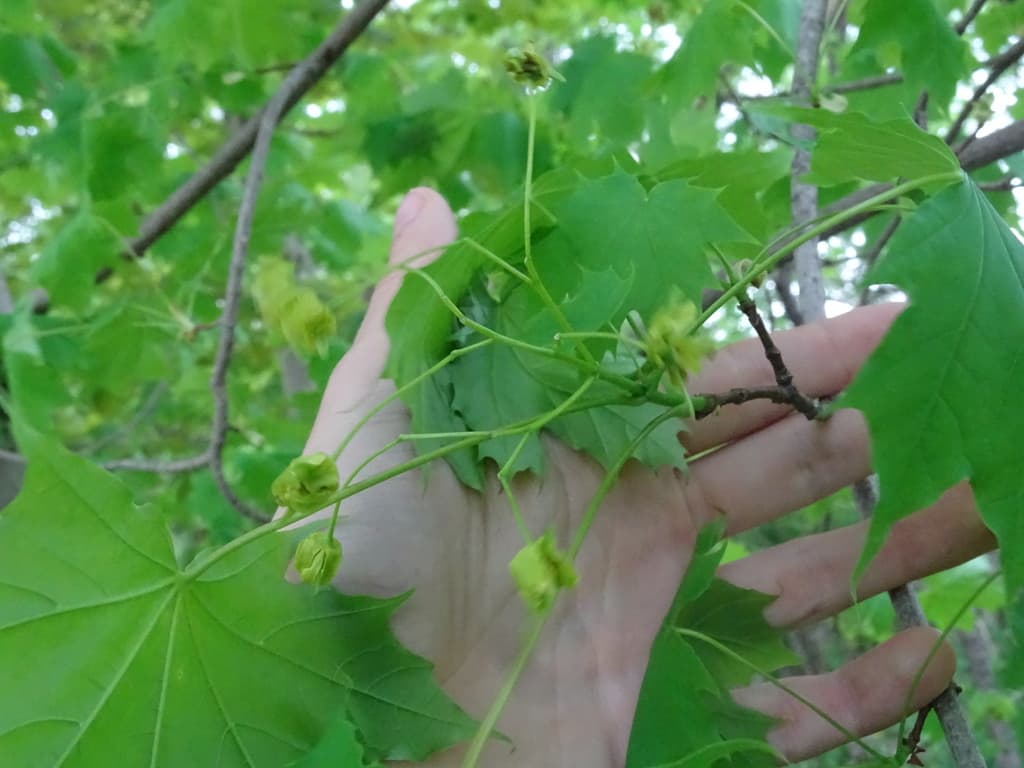
Seeds: paired samaras spread almost flat, nearly 180 degrees apart; sugar maple’s hang in a U.
Seeds September–October.
Paired winged keys spread almost straight out from each other in a wide, flat line, close to 180 degrees.
Why it matters: Native sugar maple keys hang in a narrow horseshoe instead. The spread of the wings tells you which tree is seeding the seedling carpet you are about to pull.
A woody crown too big to pull and too stubborn to cut: wineberry, multiflora rose, barberry, bush honeysuckle, tree seedlings.
Avoid: Do not clamp halfway up the stem. It snaps, and the crown stays in the ground and re-sprouts.
It can stay on site. Pulled seedlings and wrenched saplings can stay on site. Bag the winged seeds if the sapling you pulled is carrying any.
Norway maple was planted as a street tree everywhere, and its seedlings now carpet the ground under it where nothing native gets through. The trouble is that it looks like a sugar maple, and pulling a sugar maple seedling is a real loss. One check never fails and takes two seconds: snap a leaf stalk off and look at the cut.
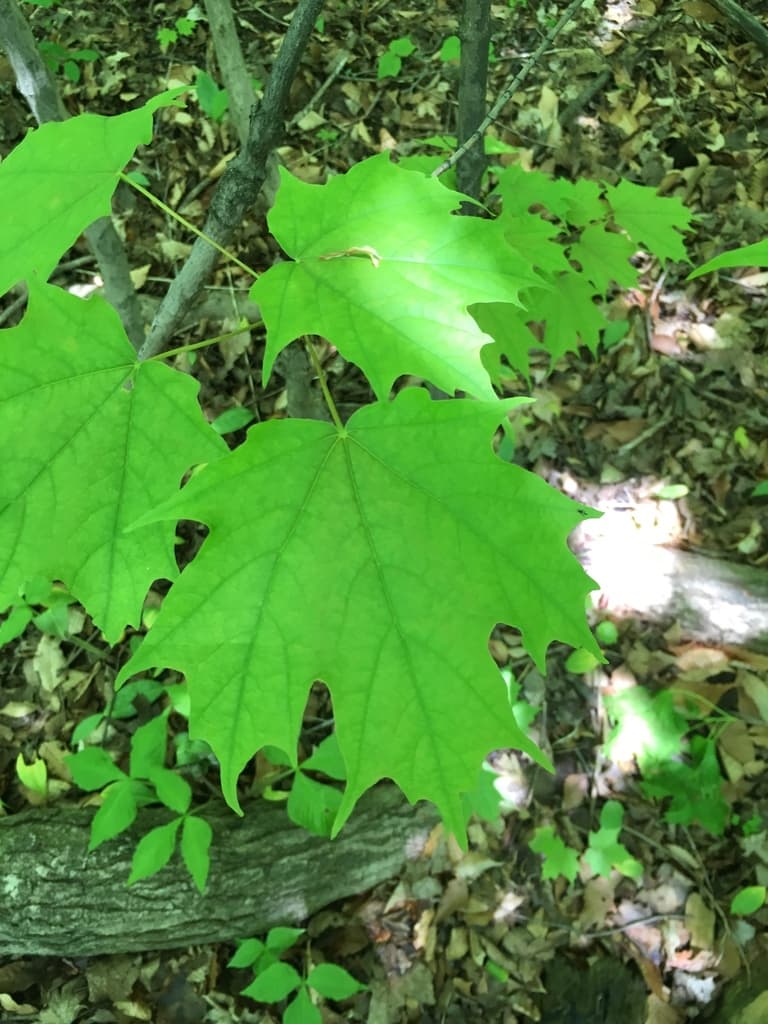
Sugar Maple
Acer saccharum
Native: keepSmooth U-shaped notches between the lobes.
Before the first cut: Snap a leaf stalk before every pull: milky sap is Norway maple, clear sap is a native maple you leave.
Pull the seedling carpets; wrench the saplings.
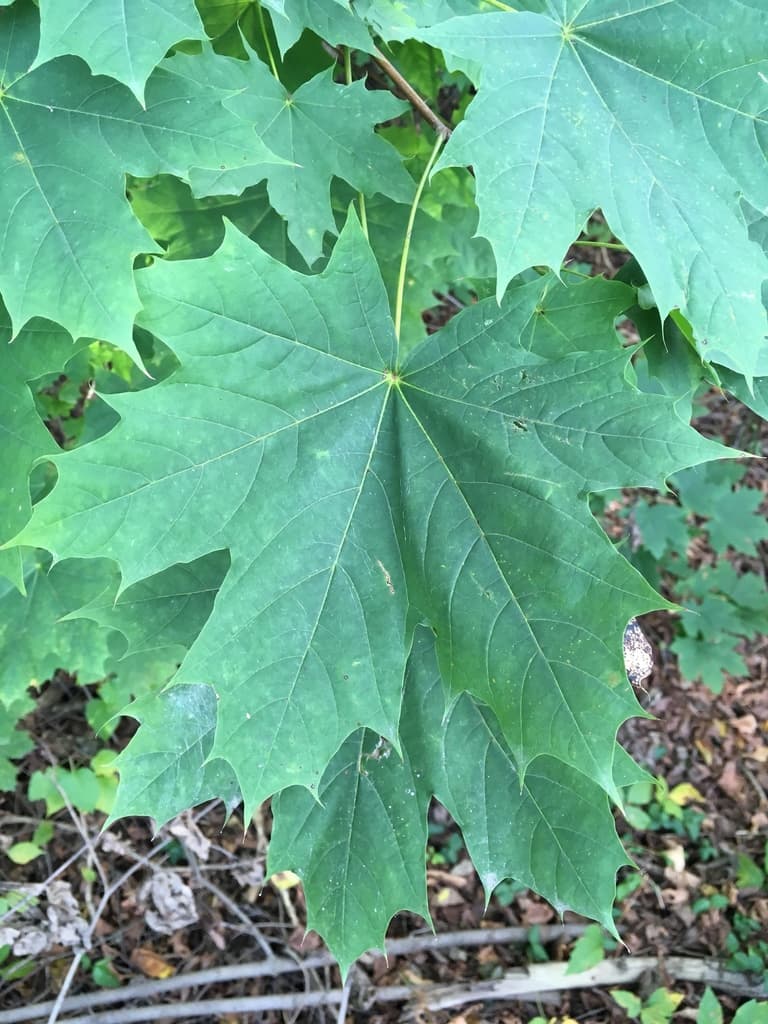
Norway Maple
Acer platanoides
Invasive: removeBroader than long, with fine bristle tips on the lobes.
Sugar Maple
The sap that beads at the break is clear and watery.
Norway Maple
The sap that beads at the break is milky white. It is unmistakable, and it works on a seedling in your hand.
Sugar Maple
Five lobes with smooth, rounded U-shaped notches between them, and only a few large teeth.
Norway Maple
Usually broader than it is long, the notches sharper, and each lobe drawn out into fine bristle-like points.
Sugar Maple
The pair hangs in a narrow horseshoe, the two wings close to parallel.
Norway Maple
The pair spreads almost straight out from each other, close to a flat line.
Sugar Maple
A mixed understory: wildflowers, tree seedlings of several kinds.
Norway Maple
A dense carpet of its own seedlings and not much else. That carpet is usually what brought you over.
When in doubt, leave the plant and ask a site lead before removing it.